Why More Manufacturers Are Switching from Epoxy to Polyurethane
GOOGIO builds pultrusion injection machines for two-component polyurethane, handling automatic metering, mixing and closed-mold injection for GRPU profiles such as solar frames, window and door profiles and cable trays. Servo metering, static mixing, precise temperature control, full PLC automation and one-touch cleaning eliminate inaccurate manual ratios, poor mixing and bubble defects. On-site acceptance testing and custom injection solutions available.
Anyone who has worked in pultrusion knows epoxy used to dominate. Epoxy performs well, but it has one hard drawback: slow curing. Once a line starts running, mold heating and pull speed have to be dialed in slowly, so output stays low. Epoxy also wets out fibers only moderately well, which causes problems with thin-wall profiles.
Polyurethane is a different story. Its low viscosity bonds readily with glass fiber, soaking through in one pass. It cures fast too — a few minutes through the mold and the profile is out. On the same line, switching to polyurethane lifts speed substantially. Add high strength, corrosion resistance and good thermal insulation, and polyurethane profiles are now widely used in solar frames, window and door profiles and cable trays.
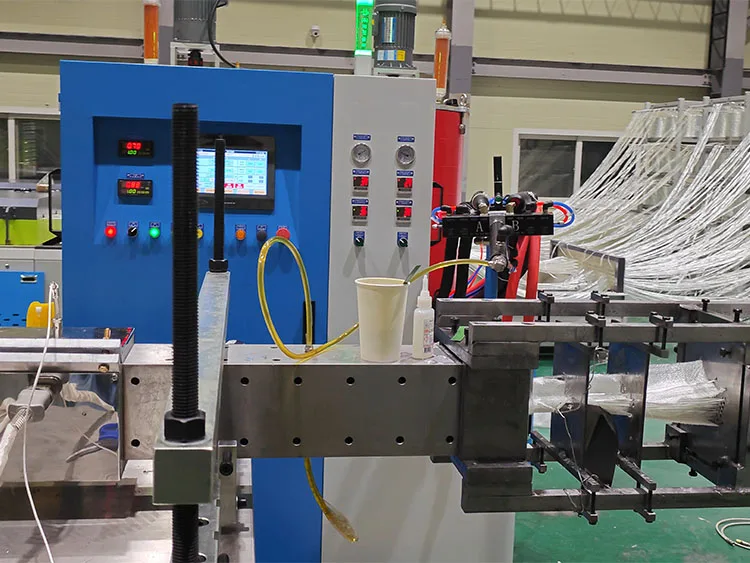
But polyurethane has a temper: it hates water. The isocyanate component reacts with airborne moisture, creating bubbles and voids inside the profile that directly undermine mechanical performance. That is why polyurethane pultrusion cannot use an open resin bath — it requires a closed-mold injection system that seals resin and fiber inside the injection box, away from moisture.
GOOGIO's polyurethane pultrusion injection machine is built for exactly this process.
It solves three core problems.
First, accurate ratio. Polyurethane is two-component: A (isocyanate) and B (polyether polyol) must be mixed in proportion. Get the ratio wrong and either the profile cures incompletely and stays soft, or the reaction runs too fast and clogs the mold. GOOGIO uses servo-driven high-precision gear metering pumps to hold ratio accuracy within a very tight tolerance. Set the ratio on the touchscreen and the machine executes automatically — no manual weighing, no risk of error.
Second, thorough mixing. Incomplete mixing leaves uneven local cure and inconsistent profile properties. GOOGIO uses a static mixer with no moving parts: components A and B pass through a spiral element that repeatedly splits and recombines them into a uniform blend. Simple, durable and cheap to maintain.
Third, stable temperature control. Polyurethane viscosity is highly temperature-sensitive. In cold weather it thickens, raising pumping pressure and destabilizing flow; in heat it reacts too fast and gels before reaching the mold. GOOGIO machines use a precision temperature control system that holds tanks and lines at constant temperature. Winter or summer, north or south, the resin leaves at the same viscosity and flow.
Beyond these three core functions, the machine includes plenty of practical features. Full PLC control with a simple interface means workers are up to speed after two days of training. Lines recirculate automatically during downtime to prevent settling and clogging. One-touch high-pressure cleaning at product changeover or end of shift — no dismantling pipes to scrub them out. Low-material alarms prompt refilling, and faults display their cause directly on screen.
GOOGIO's polyurethane pultrusion injection machines are already in service for solar frames, window and door profiles, cable trays and composite insulator rods. Every machine supports on-site acceptance testing: bring your own fiber and resin and run a trial, then order once you are satisfied. The engineering team can tailor a process plan to your specific profile cross-section, resin system and line speed.
If you make or plan to make polyurethane pultruded profiles and still rely on manual mixing and open baths — struggling with bubbles, off ratios and low efficiency — talk to GOOGIO. Their engineers work with you directly on process details and put together an injection solution suited to your product.
Need machine configuration advice?
Leave your details and an engineer will contact you within 12 hours.