
Pultrusion Process
A complete walkthrough of the pultrusion process — fiber unwinding, resin impregnation, preforming, curing and pull-cut — plus key parameters like line speed, curing temperature and resin content, and where the process fits.
Pultrusion is a mainstream continuous molding process for composites made from reinforcing fibers such as glass or carbon and a resin matrix. Its continuous pull–impregnate–shape–cure–cut sequence efficiently produces linear, constant-cross-section profiles. Success hinges on precise control of impregnation and cure rate, which is what keeps part quality consistent.
1. Core Process Steps
Fiber unwinding: Continuous fiber tows (glass, carbon) or mats are drawn from a creel, with a tension-control system holding tension steady to prevent slack or breakage and set up even impregnation downstream.
Resin impregnation: The tows are pulled into a resin bath, where liquid resin (epoxy, unsaturated polyester, etc.) must fully wet out the fibers. Guide rollers adjust fiber spread so every filament picks up resin evenly, and bath time is controlled to avoid excess or insufficient resin pickup.
Preforming and excess resin removal: The impregnated tows enter a preforming die whose cavity roughly matches the profile cross-section (slightly oversized). It squeezes out surplus resin and trapped air while aligning fibers in the designed direction ahead of cure.
Heated curing: The preformed fiber-resin bundle passes into a heated curing die held at a set temperature by electric or hot-oil heating — typically 80–160°C depending on the resin. The resin crosslinks and cures inside the die, and cure time must match line speed so the profile is fully cured on exit.
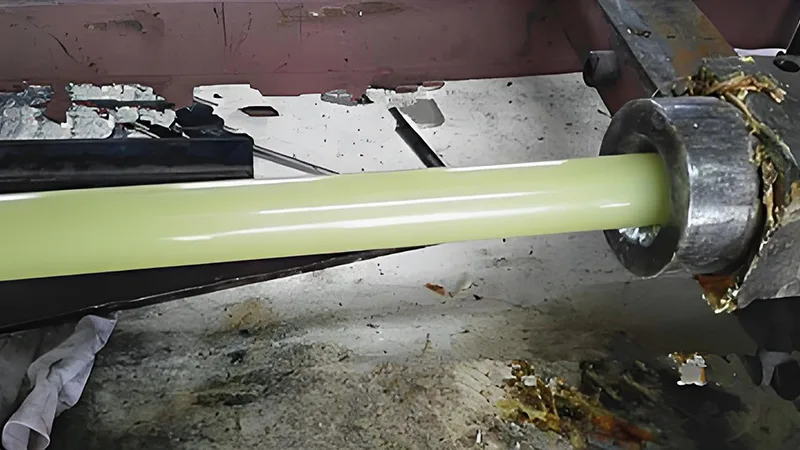
Pulling and cutting: The cured continuous profile is drawn out smoothly by a puller (usually caterpillar type for more even pulling force) and cut to length by automatic cutting equipment.
2. Key Process Parameters
Line speed: Must match cure speed — too fast leaves the profile undercured, too slow kills throughput. Production settings are usually based on the resin's cure behavior, typically 0.5–5 m/min.
Curing temperature: Best controlled in zones (low-temperature pre-cure, then full cure at higher temperature) to prevent resin degradation from overheating and avoid overly long cure times from running too cool.
Resin content: Controlled by adjusting preforming die squeeze pressure and resin bath level. Resin content is usually 30%–50%, a ratio that directly affects strength and corrosion resistance.
3. Advantages and Applications
The process offers a high degree of automation, continuous production and strong throughput. Profiles come out with well-aligned fibers, high strength, good consistency and little material waste. It is mainly used for linear, constant-cross-section composite parts such as FRP anti-corrosion pipe, cable trays, building profiles and wind blade support rods, and is widely applied in chemicals, construction, new energy and transportation.
Need machine configuration advice?
Leave your details and an engineer will contact you within 12 hours.