
Coating-Free Aliphatic PU Pultrusion Profiles: Closed-Mold Injection for Stable Output
Aliphatic polyurethane pultrusion profiles contain no benzene rings, resist UV and yellowing, and come off the line ready to use without coating. Whether coating-free production works depends on closed-mold injection: ratio accuracy, sealed delivery and continuous stability. Here are the three key metrics and startup tips.
Outdoor profiles face years of UV, rain and temperature cycling. The usual fix is a coating applied after extrusion or pultrusion. Coatings do slow aging, but they add process steps and VOCs, and a scratch becomes the starting point for degradation. Aliphatic polyurethane pultrusion takes a different route: the material itself is weather-resistant, so profiles can be used straight off the line with no painting step at all.
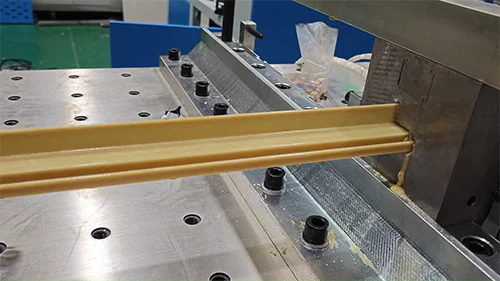
Why aliphatic systems can skip coating
Conventional aromatic polyurethanes contain benzene rings, which photo-oxidize under UV and show up as yellowing, chalking and gloss loss. Aliphatic polyurethanes use isocyanate systems without benzene rings, giving far better light stability: color and surface stay stable through long outdoor exposure, so no coating is needed to block UV.
Polyurethane also offers good toughness and low cure shrinkage, bonds tightly to glass fiber, and forms a dense, low-porosity surface. Only a surface of that quality makes coating-free viable.
Weather-resistant resin is not a weather-resistant part
Even the best resin will produce bubbles, dry fiber, flow marks and color variation if injection pulls in air or moisture or the metering drifts. No formulation can fix these defects; they can only be sanded and repainted, which defeats the purpose of going coating-free.
In other words, coating-free production depends not on one material spec but on the stability of the whole pultrusion line, especially metering, mixing and delivery of the two-component resin.
Three metrics to watch in closed-mold injection
Ratio accuracy. Any deviation in the A/B ratio shows up directly in cure and surface quality: too little B leaves the surface tacky and undercured; too much makes it brittle and prone to cracking. PLC-controlled two-component systems typically hold ratio accuracy within ±1% and must not drift over long runs.
Sealed delivery. Polyurethane is moisture-sensitive; once the resin meets air during delivery, it absorbs moisture and causes bubbles and cure problems. Closed-mold injection keeps resin sealed from tank to die, preventing air contact and reducing volatiles in the workshop.
Continuous operation. Pultrusion is a continuous process, so pressure or flow pulsation in injection produces periodic defects along the profile. Only servo metering with closed-loop pressure control keeps output and cross-section consistent through 24-hour production.
Where to start
PV module frames: long-term weather and corrosion resistance, plus savings on painting;
Architectural window and door profiles: strict color stability, no yellowing on exposed surfaces;
Cable trays and supports: outdoor or damp service, where longer maintenance intervals matter;
Carbon fiber and other high-performance pultrusions: surface quality directly affects assembly and appearance.
Startup tips
Confirm the resin's pot life and die temperature window before setting injection pressure and line speed; don't apply one parameter set to every system;
Watch the surface on the first trial runs: bubbles, dry fiber and flow marks usually appear within the first 10–15 minutes;
Log ratio, resin temperature and pressure for traceability, so batch color differences can be compared against data;
Clean the mixing head promptly after shutdown; once polyurethane gels in the mixing chamber, teardown costs far more than routine maintenance.
Coating-free is not a single-material selling point but the result of matching the resin system with the injection process. Choosing the right resin is only step one; get two-component ratio, sealing and continuous stability right, and coating-free profiles can be mass-produced reliably.
Need machine configuration advice?
Leave your details and an engineer will contact you within 12 hours.