
Two-Component Dispensing Machine Working Principle Explained
How does a two-component dispensing machine meter, mix and dispense the A and B components accurately? This article breaks the process into four stages — feeding and metering, mixing, dispensing and coating, and intelligent control — and explains the key figures behind machine selection and parameter setting.
A two-component dispensing machine is the core equipment for the automated proportioning, mixing and coating of materials in modern precision manufacturing. Its central task: take two separately stored fluid components (A and B) that only cure once mixed at a specific ratio — epoxy resin, silicone, polyurethane — and deliver them to a defined position in a controlled way. Its working principle falls into four core stages.
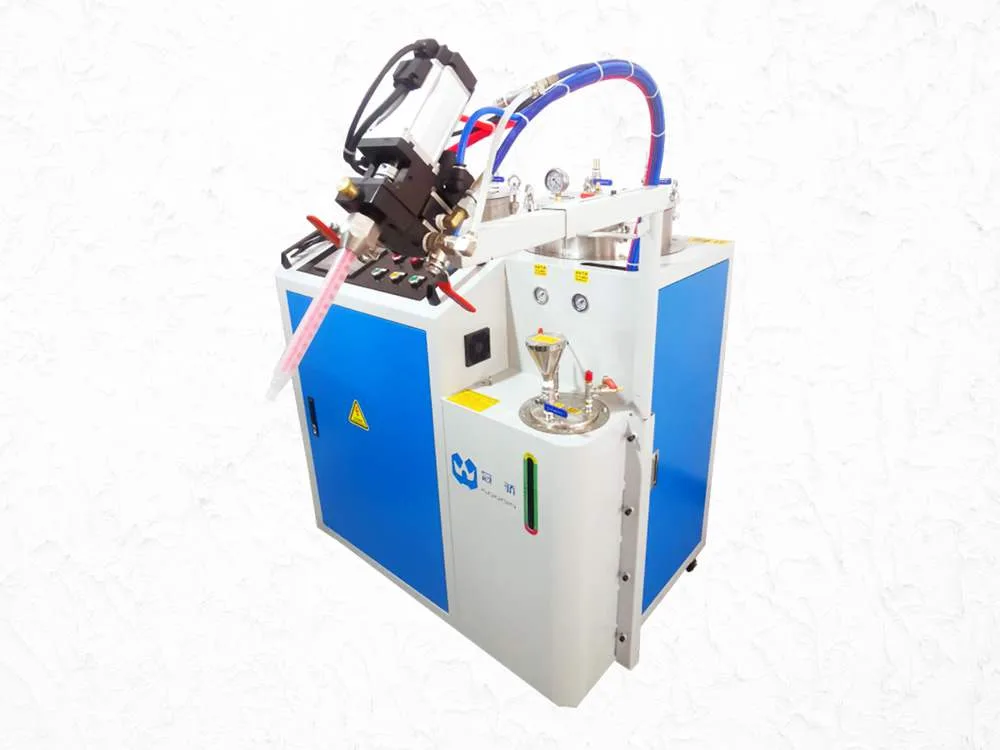
Precision Metering and Feeding
This is the first step in guaranteeing an accurate mixing ratio. The machine is normally fitted with two independent feeding systems.
- Feeding units: components A and B are stored in separate tanks. The tanks usually offer stirring, heating and vacuum degassing to keep material properties stable.
- Metering drive: high-precision metering pumps (gear, piston or screw pumps) driven by servo or stepper motors. Based on the set mixing ratio (for example 1:1 or 10:1), the control system governs the output speed and stroke of both pumps precisely.
- Key figure: metering accuracy, typically ±0.5% to ±1%, is the basis for consistent final product performance.
Efficient, Uniform Mixing
Mixing the two proportioned streams instantly and evenly determines cure quality and the homogeneity of the finished part.
- Mixing methods — two main types:
- Static mixing: the most common approach. The A and B streams are forced together into a static mixing tube fitted with special spiral elements. As the fluid passes these fixed elements it is repeatedly split, cut and recombined, achieving mixing at molecular level. There are no moving parts, maintenance is simple, and the mixer is a single-use consumable.
- Dynamic mixing: used where extremely high mixing uniformity is required or viscosity is very high. A high-speed rotating mixing head actively shears and stirs the fluid inside the chamber. Mixing is more thorough, but the structure is more complex and requires cleaning.
- Mixing quality: whichever method is used, the goal is close to 100% mixing uniformity, so that the cure reaction is complete and there is no local variation in properties.
Controlled Output and Dispensing
The mixed material then has to be applied precisely to the workpiece.
- Output control: by regulating the overall output frequency of the metering pumps or using independent on/off valves such as needle valves, the shot size is controlled precisely to suit dots, lines, areas or cavity filling.
- Motion: the dispensing head is usually mounted on a multi-axis motion platform (three-axis gantry, robot arm). Programmed trajectory, speed and height give automatic, repeatable, accurate coating along complex 2D or 3D paths.
Intelligent Control and Monitoring
All of the above is coordinated by a central control system, typically an industrial PLC with a touch-screen HMI.
- Process control: the system integrates the start/stop and speed of the metering pumps, switching between mixing modes, the opening of the dispensing valve and the motion path — fully automated end to end.
- Recipe management: hundreds of "recipes" (ratio, pressure, flow, path and all other parameters) can be stored and recalled, so switching between products is fast.
- Live monitoring: pressure, temperature and level are monitored, with automatic alarms on abnormality to keep the process stable and the machine safe.
Summary: the Core Workflow
In short, a two-component dispensing machine works as one continuous closed loop: independent feeding → precision ratio metering → instant, efficient, uniform mixing → accurate, controlled dispensing and coating → intelligent monitoring and adjustment throughout.
Through this highly integrated principle, a two-component dispensing machine turns a complex chemical reaction into a stable, reliable and efficient automated industrial process — indispensable equipment for raising the reliability of electronic products and for forming complex composite parts.
Need machine configuration advice?
Leave your details and an engineer will contact you within 12 hours.