
Static vs Dynamic Mixing in Two-Part Dispensing: How to Choose
Static mixing cuts the adhesive with supply pressure; dynamic mixing shears it with a motor-driven rotor. They suit different mix ratios, viscosities and consumable cycles. A comparison table breaks down the structural differences, replacement intervals and selection criteria, plus a trial-mix check before going live.
Swap in a new adhesive on the same line and the dispensed bead starts coming out uneven — often the culprit isn't the dispensing machine itself but the wrong mixing tube. Static and dynamic mixing both send Part A and Part B through a length of tubing to blend them, yet their driving force, suitable mix ratios and maintenance rhythm are completely different. Nailing down these differences before you select a model saves far more trouble than tweaking parameters after the fact.
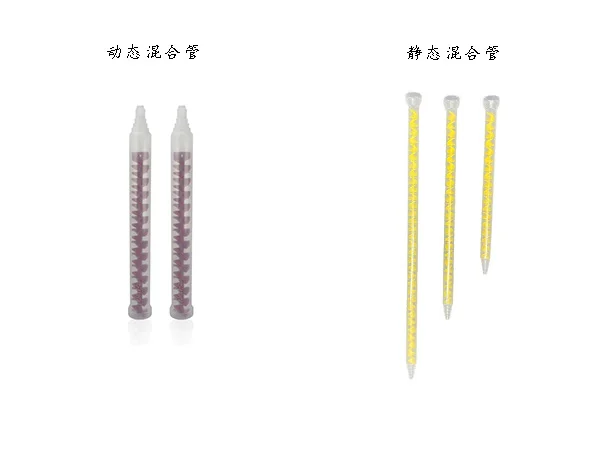
Different driving force, two technical routes
Static mixing is passive: the tube holds a set of fixed helical elements, alternating left- and right-hand, and the adhesive is pushed forward by supply pressure. Each pass through an element cuts, flips and recombines the flow, and the layers stack up until mixing is complete. There are no moving parts and no separate power supply.
Dynamic mixing is active: a stirring rotor inside the chamber is driven at high speed by a motor — commonly up to a thousand-plus rpm — forcing shear that breaks the two components apart and recombines them. The power comes from the motor, not from the fluid's own pressure.
In one line: static mixing cuts with structure, dynamic mixing stirs with rotation.
Shape: length gives it away
Static mixing tubes are usually longer, commonly around 38 cm; dynamic tubes are shorter, generally around 18 cm. Internally, though, the element layout is similar — both rely on alternating left- and right-hand elements to create cutting and recombination. The real difference is the driving force: flow pressure versus motor speed.
One easily overlooked detail: the longer the static tube, the greater the pressure loss along its length. With high-viscosity adhesive and a long tube, the supply pump has to overcome that extra resistance, and actual flow may fall short of the setpoint — factor the pressure margin into your selection.
Mix ratio and viscosity set the baseline
Static mixing suits systems with close ratios and lower viscosity, such as 1:1 or 2:1. The catch is that the two components' viscosities must not differ too much: if one is thick and the other thin, they travel at different speeds, the elements cut them out of sync, and the output tends to streak with patches of incomplete cure.
Dynamic mixing is made for widely disparate ratios or high viscosity — 4:1, 5:1, 10:1, even 10:3. In these systems the base is thick and the hardener thin, and the rotor shears at high speed the moment the adhesive enters the mixing chamber, dispersing both components together for more controllable uniformity.
Consumable cost: look at the replacement cycle, not just the unit price
A dynamic mixer will certainly blend a 1:1 adhesive, but it doesn't pay off over the long run. The stirring core spins at high speed under motor drive, so the helical core and valve seals wear far faster than a static tube. In continuous production, a static tube typically lasts 15–30 days, while a dynamic tube needs replacing roughly every 7–15 days.
Another point easily missed: the dynamic stirring hook runs at high speed for long periods and can fatigue and snap. If it breaks inside the mixing chamber, the cleanup and downtime cost far exceeds that of a mixing tube. Put the stirring core, seals and hook on the inspection checklist — listen for abnormal noise and watch for vibration each shift, and tear down weekly.
| Item | Static mixing | Dynamic mixing |
|---|---|---|
| Driving force | Supply pressure, no moving parts | Motor-driven rotor at high speed |
| Typical tube length | About 38 cm | About 18 cm |
| Suitable mix ratio | Close ratios such as 1:1, 2:1 | Wide ratios such as 4:1, 5:1, 10:1, 10:3 |
| Adhesive viscosity | Low to medium, similar components | High viscosity, or large viscosity gap |
| Consumable life | About 15–30 days | About 7–15 days |
| Maintenance focus | Replace the mixing tube on schedule | Fatigue of stirring core, seals, hook |
Output rate and process fit
On dispensing speed alone, the two methods show no real difference — the pace is set mainly by the supply pump's flow rate, not the mixing method. Where they truly diverge is process fit:
Filled systems (thermal powder, alumina, glass fiber, etc.): high shear demand, so dynamic mixing is more stable — but seals wear faster, so shorten the inspection interval accordingly;
Fast-curing adhesives and small batches with many variants: static tubes change fast and clean easily, keeping downtime low;
High-viscosity, long-line delivery: watch the static tube's pressure loss along its length, and shorten the tube or raise supply pressure if needed;
Continuous high-volume lines: don't compare consumable unit prices alone — factor in the time cost of tube-change downtime.
Four steps to pick a mixing method
Start with the mix ratio. Within 2:1 with similar viscosities, favor static; 4:1 or above, or a clear viscosity gap, go straight to dynamic.
Then the adhesive's characteristics. High viscosity, filled or settling-prone systems are steadier with dynamic; low-viscosity, fast-curing systems are simpler with static.
Calculate total lifecycle cost. Tube unit price × replacement frequency + downtime, not just the purchase price.
Check on-site maintenance capability. Shops without an inspection routine or spare parts should favor static to reduce unplanned stoppages.
Run a trial mix before going live
Spec sheets only point the way; the final call needs your actual adhesive. Do three things:
Dispense a 10–20 cm sample strip, cut it lengthwise and check that color and cure are uniform, with no streaks or bubbles;
Weigh adhesive dispensed over a fixed time and compare against the theoretical ratio to confirm metering hasn't drifted;
Record the adhesive and ambient temperatures at the time — temperature changes viscosity, so the same parameters may behave differently in winter and summer.
No mixing method is inherently better; matching the ratio, viscosity and line rhythm is what counts. When in doubt, run a trial mix with your actual adhesive before settling on the machine model and mixing tube spec — far more reliable than deciding from catalog parameters.
Need machine configuration advice?
Leave your details and an engineer will contact you within 12 hours.