
Pultrusion resin supply: bath vs. metering box vs. pressurized box
The real dividing line between a resin bath, an atmospheric injection box and a pressurized injection box isn't pressure — it's when the resin meets the fiber. A comparison table covers viscosity, fiber content limits, resin utilization and VOCs, plus four pre-launch checks and a step-test tuning method.
On the same pultrusion line, switching the resin supply method can cut resin waste from 20% to under 5% and may even double line speed. Or it can change nothing at all — in which case the problem is yarn bundle layout. The real dividing line between the three methods isn't pressure level; it's when the resin meets the fiber.
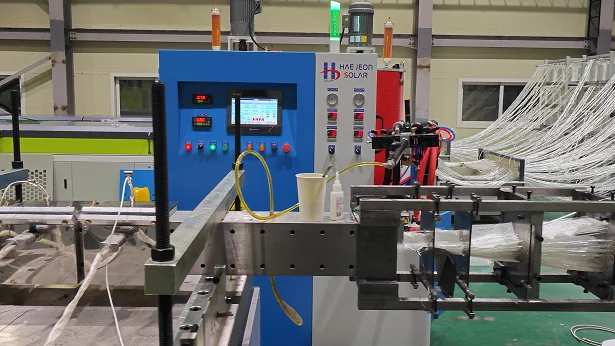
The real dividing line: wet-out timing, not pressure
A resin bath soaks the fiber before it enters the die. The fiber bundle passes through an open bath and wets out by capillary action and gravity, so it is thoroughly soaked before reaching the die.
An injection box wets the fiber just before the die. The fiber is first laid out evenly and enters a closed cavity, where resin contacts it only seconds before gelation begins.
That single difference drives everything downstream: VOCs, resin waste, fiber content limits and line speed. So don't start with "how much pressure?" — start with "what viscosity is my resin, and how much fiber content does the profile need?"
Compare the three at a glance
Wide table — swipe left and right on mobile for the full comparison
| Item | Resin bath | Atmospheric injection box | Pressurized injection box |
|---|---|---|---|
| Wet-out method | Open bath, capillary + gravity | Semi-enclosed, gravity or low-pressure pump | Fully enclosed, pump pressure forces penetration |
| Typical working pressure | Atmospheric | 0.1–0.3 MPa | 0.3–1.5 MPa |
| Resin viscosity range | 200–500 mPa·s | Low to medium | Medium-low to high |
| Fiber volume content | Low | Medium | Up to 60%–70% |
| Resin utilization | 80%–90% | About 90% | Over 90% |
| Relative VOC level | High (baseline) | 30%–50% lower | About 1/5 of a bath |
| Sensitivity to yarn layout | Low | Medium | High |
| Typical applications | Cable conduit, fence posts | General industrial profiles | Structural parts, high-fiber-content profiles |
Resin bath: cheap equipment, three hidden costs
Low-viscosity systems only. Polyester and vinyl ester at 200–500 mPa·s are its comfort zone. Any thicker and the inside of a coarse roving bundle never wets out — that's where dry fiber and voids come from.
10%–20% resin waste. Resin not carried off by the fiber has to be recovered with a return system, and the recovered material still needs purity control.
An open bath is an open bath. Styrene evaporates, bringing shop-floor odor and compliance pressure; as monomer escapes, viscosity climbs, so you test and top up constantly.
It suits civil profiles with modest appearance and mechanical demands — cable conduit, fence posts — and lines with low output and frequent material changes. That's fine. Forcing it onto high-strength structural parts is where it fails.
Atmospheric injection box: the value sweet spot for most industrial profiles
The box is open to atmosphere and fed by gravity or a low-pressure pump, typically at 0.1–0.3 MPa. Versus a bath, VOCs drop 30%–50% and wet-out uniformity improves noticeably, while the structure stays simple and maintenance cheap.
It solves "uniform wet-out," not "high fiber content." Above roughly 55% fiber volume content, or with very dense yarn layouts, atmospheric pressure simply can't push resin in.
Pressurized injection box: built for high fiber content and high line speed
Fully enclosed, with pump pressure forcing penetration, typically 0.3–1.5 MPa. (Some suppliers quote 2–10 bar, i.e. 0.2–1.0 MPa — it depends on the equipment and resin system, so don't copy the numbers blindly.)
Fiber volume content up to 60%–70%;
Resin utilization above 90%, with VOCs about one-fifth of a bath;
Closed-loop pressure control holds resin content within ±1%;
Higher line speeds — resin spends less time heated and exposed to air.
The trade-off is higher equipment cost, plus high sensitivity to yarn layout — covered separately below.
Why polyurethane systems essentially require closed injection
This is easily overlooked when switching materials.
First, the A component reacts with water. The isocyanate component is highly moisture-sensitive; an open bath lets it absorb humidity straight from the shop air, planting the seeds of bubbles and curing faults. The work area usually needs relative humidity below 60%, with the A component held at 35–45°C and within ±2°C.
Second, polyurethane must be mixed inline. Components A and B are combined in the mixing head at ratio and pass through a static mixer before dispensing — an open bath has no such step.
Third, gel time is short. Typically 10–30 minutes, so resin sitting in a bath starts to thicken; both level and temperature need watching.
For polyurethane pultrusion, then, an injection box isn't optional — it's a prerequisite. The only remaining choice is atmospheric or pressurized. It's also why coating-free aliphatic polyurethane profiles generally use closed injection.
Four things to confirm before installing an injection box
1. Yarn bundle layout. Injection pressure can't fix resin-starved or resin-rich areas. If the yarn isn't evenly distributed, pressure only makes rich zones richer and lean zones leaner — the most common reason a new machine "makes no difference." First work out which category your line falls into from the characteristics of the pultrusion process, then decide whether to add pressure.
2. Die entry taper. The usual range is 2°–4°: below 1.5° gives insufficient compaction and dry spots; above 5° generates frictional heat and yarn breakage at the entry. Taper must be adjusted for cross-section and fiber volume fraction — unidirectional rod needs a larger taper than a rectangular profile.
3. Cleaning system. With polyurethane, flush after 5 minutes of downtime — don't wait for it to cure. Specify automatic cleaning and a buffer tank as part of the package: the buffer tank serves small trial batches and also lets you flush the pump and lines quickly, far easier than retrofitting later.
4. Pressure monitoring. Fit a pressure sensor at the pump outlet, with automatic shutdown on overpressure and automatic restart on recovery. Pressure faults usually appear before ratio faults — the earliest alarm point you have.
Setting parameters: don't expect one-shot tuning — use step changes
You almost never hit the "optimum" on a new profile in one pass. Step changes are more reliable:
Fix the ratio and die temperature, then run three stages at 300, 500 and 700 mm/min;
At each stage measure three things: Barcol hardness, short-beam shear strength and surface quality;
Interpolate between the three points to find the stage with adequate hardness and no surface cracks.
Reference criteria (polyester systems): Barcol hardness of 45–55 is normal; below 40 means insufficient surface cure, usually from low zone-3 temperature or excessive line speed; above 60 signals over-cure embrittlement, especially in thin-wall parts.
Three common misdiagnoses
Surface cracks? Slow the line down. Cracks have at least three causes: preheat zone too hot (surface cures while the core still flows, dragging against the die wall and causing shear cracks), exit temperature too high meeting cold air (thermal shock), or insufficient internal release agent (0.5–1.0 phr in most systems). Identify the cause before touching parameters.
Bubbles? Add deaeration. First find where the bubbles come from: the resin (moist raw material, air from mixing) — check the tank and mixing head; or the fiber (poor wet-out, air carried in the yarn) — check injection pressure and layout. Get the direction wrong and every adjustment makes it worse.
A new injection box will raise line speed. Raising speed is a whole-system job: resin reactivity, die length and preheat method all have to keep up. Swap only the injection box and you'll usually hit a wall in the cure zone.
Conclusion
Choosing a resin supply method really means answering three questions: what's my resin viscosity, what fiber content do I need, and how many meters a year do I run? Once those are settled, the choice is rarely in doubt — the rest is tuning.
Need machine configuration advice?
Leave your details and an engineer will contact you within 12 hours.